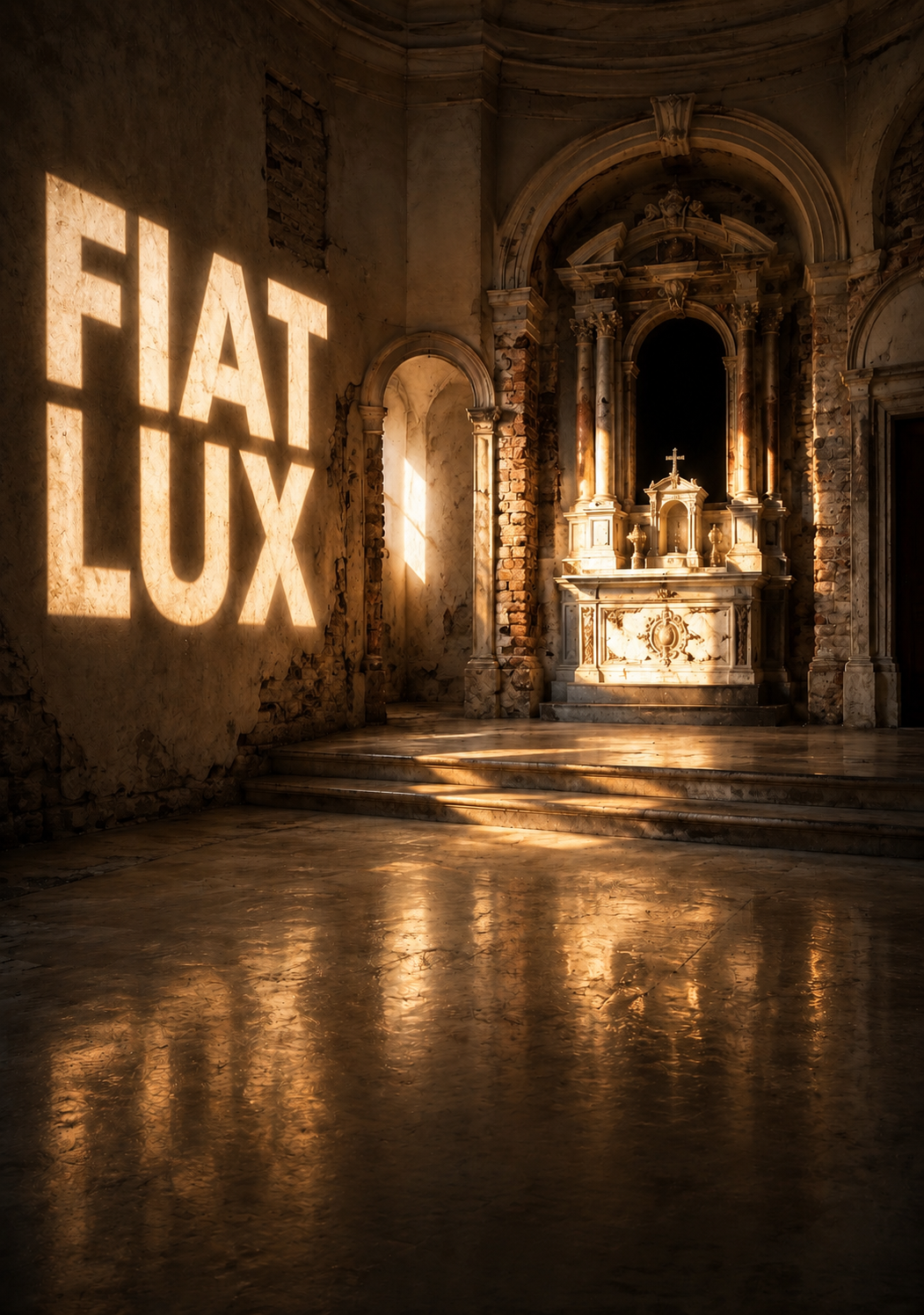
FIAT LUX
Church of Our Lady of Health, Piran, July– August 2026
"Fiat lux." The first command of creation brings forth not matter, but light. Before it there is no form, only darkness over the deep, and the first act is one of separation: light from darkness, the visible from the unseen. The world begins as the mere possibility that matter might be seen at all. Light is the condition of visibility, and yet it is never itself seen; we see only what it touches. That which makes seeing possible withdraws from the seen, and in this withdrawal lies the whole teaching of the image. Photography, phōs and graphē, a writing done in light, performs exactly this: it does not create the body before the lens, only permits it to leave its imprint. As creation wrests form from darkness, photography draws a likeness out of blackness by measured exposure. Fiat, not fecit: not "I have made," but "let there be."
The Church of Our Lady of Health, Beata Vergine della Salute, took its name of healing in the seventeenth century, when plague laid waste to Istria, supplanting an older dedication to Saint Clement, patron of sailors. Salus did not yet, in that age, separate health from salvation: the healed body and the redeemed soul were one single plea, offered over the same fragile flesh. This place has never been stripped of its sanctity, and precisely for that reason the question posed here cuts differently. It does not ask whether art can restore holiness to desacralized stone, but something less consoling still: whether an image, worn down in an economy of endless visibility to loose change, can, within walls that never lost their ritual power, live again as supplication rather than report. The sacred and the profane are not at odds within this nave; both are names for the same touch of light.
That very touch greets us at the threshold: light falls aslant across a wall, laying a standing stone's shadow in the shape of a cross. So Igor Andjelić sees, through the lens of a telephone, that same small machine which daily disgorges an unruly flood of empty images. What first appears a limitation is, in truth, restraint: an instrument of haste, slowed until it learns again to perceive. Andjelić does not go in search of his subject; he waits for it. In one image, the water's surface overturns the world: treetops grow downward, clouds settle on the floor, and among the water lilies hangs a figure with an open umbrella, upended above its own reflection, so that the sky hangs beneath its feet, and still the world remains, held within the surface, not swept away. This is the oldest gesture of consecration without ceremony: an ordinary thing is blessed simply by being looked at as light itself looks at it. His lens does not elevate things. It leaves them where they lie, wrapping them in a silence within which more is disclosed than their daily use allows. Ulay holds the opposite shore. He never took the photograph for a record of reality, but for a question put to it: what remains of a person once the body has vanished into an image. With his own likeness, with an exposure left to fade, he tested a trace that could never be summoned back. His whole life circled a frail and shifting skin; and the image, rather than holding the body fast, let it go, so that the flesh recedes from its own trace, leaving only the outline of what had been. In Andjelić, light comes to rest upon the thing; even an inverted world stays caught within the water's skin. In Ulay, the body recedes from the very image that once bore it. Two ways in which the same light reaches into flesh.
Together they form a single liturgy: a requiem told through light. One of the Mass's prayers asks "et lux perpetua luceat eis," and this exhibition does not turn those words toward a final day, but carries them into the image here and now, letting that radiance fall on the fleeting, the forsaken, the living flesh, with the same merciless tenderness. Morning light gilds a forgotten body in the same gold that painting once reserved for saints. Light does not choose. Like the sun that rises on the just and the unjust alike, it falls upon abandoned flesh with the same exactness as upon an altar cloth. The dignity of flesh rests not on its fate, but on the mere fact that it was. And where the Word was to become flesh, flesh comes first: touch knows what the concept has not yet found words for. Painting has always known this mercilessness. Mantegna's dead Christ, foreshortened from the soles of the feet upward, is a bare, horizontal weight of flesh; before Holbein's corpse in the tomb, as Dostoevsky wrote, one might lose one's faith altogether, and Kristeva read in it the withdrawal of every promise of resurrection. This is no desecration of the sacred, but its deepest logic: kenosis, self-emptying, in which the divine discloses itself in a body that promises nothing. Holy Saturday, the day God is dead and not yet risen, is the one hour in which an image is forbidden to lie. "Fiat lux" carries on this inheritance: it does not beautify the body, nor redeem it, but holds it within the light just long enough that it be seen as it is.
The temple does not consecrate the image from outside. It grants it no sanctity; it unfolds one: it shows that the sacred is not something the gaze creates, but something the gaze receives, because it had already been met by it before. Sacred space, here, is not a frame but a proof. Photography once tore the image from cult and left it only exhibition value; in this space its ritual value is restored, and with it everything the surfeit of images had taken: the right to linger before it, the unrepeatability of what happened only once, the power to be looked back at. The prayer for eternal light upon the dead turns, at last, into a prayer for sight. For what the exhibition ultimately asks is not whether art belongs within a church, but whether we still know how to look, long enough, and free enough of a ready vocabulary, for the image to begin, once more, to think back at us. Where the endless scroll flattens all into indifference, one single act of beholding survives, in which, for an instant, the difference returns between what we merely observe and what we surrender ourselves to: between looking and prayer.
Light, then, does not create the world; it only prepares a place for the world to appear, and in so doing, withdraws itself. What remains is not an explanation. It is a glow, in which fragile flesh, for one moment, reveals itself as holy.
Fiat lux.